You face a real choice with a custom mist spray bottle: PETG shapes or flocked PE finishes. The right pick depends on your application, performance needs, compliance rules, and budget. No single option wins everywhere.
Lisson supplies both options, so this guide aims at fit, not favoritism. It gives you practical criteria to match material and design to your product. Before you read on, identify your application: skincare, personal care, household, or travel. That choice shapes every decision about your fine mist spray bottle, from the sprayer to the fine mist itself.
Key Takeaways
-
Choose PETG for clear, tough bottles that show off your product and resist breaking.
-
Choose flocked PE for a soft, matte feel that hides fingerprints and adds a premium touch.
-
Test your formula with the sprayer early to ensure a fine mist and avoid clogs.
-
Match the sprayer neck size to the bottle to prevent leaks and ensure a good fit.
-
Request samples to check the feel, spray pattern, and overall quality before you buy.
PETG Shapes for a Custom Mist Spray Bottle
Clarity and Design Flexibility
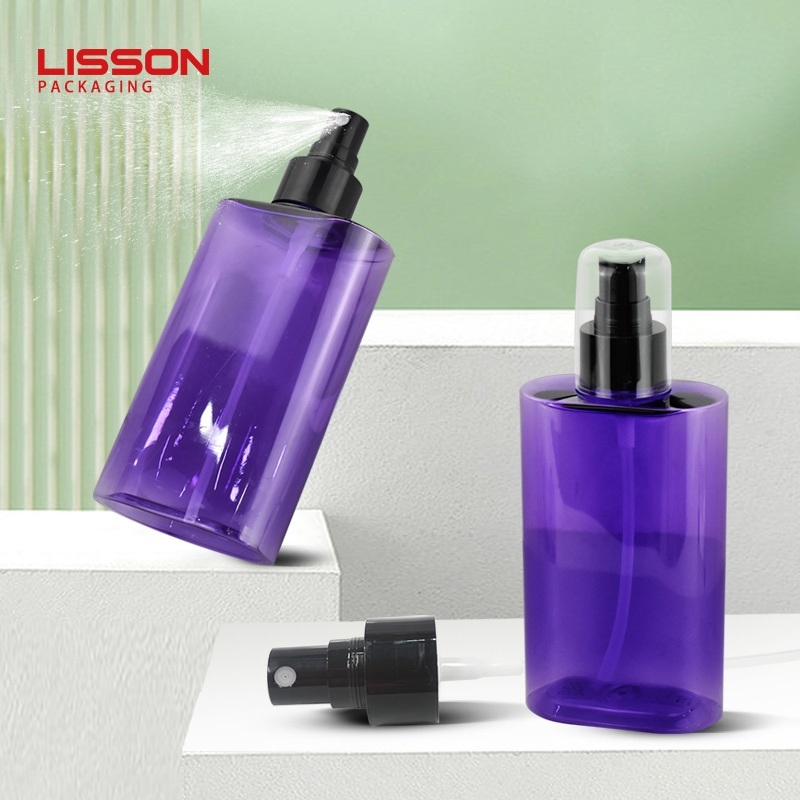
PETG gives you glass-like clarity with plastic toughness. Light passes through at 85–88%, so the liquid inside stays visible and the shelf presence feels premium. The material also holds its shape well, which opens up oval, round, and squared profiles. An oval format such as the serum mist spray oval PETG bottle shows how far you can push form without losing structural stability.
Rigidity matters here. A stiff wall keeps the bottle from flexing when you press the sprayer, and that steady pressure supports a consistent spray result. You can pair PETG bodies with a range of misters and sprayers, add logos or badges, and still keep a clean silhouette. Lisson can mold these shapes to your drawing, so design freedom does not force a compromise on function.
Where PETG Fits Best
PETG suits skincare and personal care lines that want visual appeal plus practical durability. Impact resistance runs 2.0–3.0 ft-lb/in under ASTM D256, and the material flexes instead of shattering. It weighs roughly one-fifth of glass, which lowers freight cost and reduces damage claims. Chemical resistance to alcohols, oils, and fragrances also keeps the formula stable inside the bottle.
"For skincare packaging and personal care products, PETG balances premium looks with practical performance. You gain a material that elevates your skincare line without the fragility of glass."
That profile fits facial mist products, setting spray formats, and travel sizes. A fine mist spray bottle in PETG works well when clarity sells the product and shipping demands toughness. PETG is not the only answer, though. Soft-touch finishes win where hand feel and matte branding matter more than transparency.
Flocked PE Finishes and Soft-Touch Appeal
What a Matte Flocked PE Plastic Square Bottle Delivers
A flocked PE finish changes how a bottle feels in the hand. The process bonds fine fibers to the plastic surface, and the result is a soft, matte touch that hides fingerprints and small scuffs. A matte flocked PE plastic square bottle shows this well. The squared profile gives you a stable grip, and the flocked skin adds a quiet, premium feel that glossy plastic cannot match.
The matte surface also supports branding. Logos and badges sit cleanly on the soft texture, and the low sheen keeps the look understated. Lisson applies flocking to PE bodies in several shapes, so you can keep a square silhouette and still get the tactile finish your line needs.
Where Flocked PE Fits Best
Flocked PE suits skincare and personal care products where hand feel drives the purchase. A facial mist in a flocked bottle feels warmer and more controlled than a bare plastic shell. The texture also reduces slip during use, which matters for a fine mist spray bottle you hold close to the face.
This finish fits premium gift sets, travel kits, and gift-with-purchase items. It also works for brands that want a matte look without painting or coating the bottle. Consider your formula before you commit. Some solvents and oils interact with surface treatments, so check compatibility with Lisson early. Flocked PE rewards brands that lead with touch and matte branding, while PETG leads with clarity.
Fine Mist Spray Bottle Performance and Compatibility
Spray Result, Formula, and Compatibility
Your spray result depends on droplet size. A custom mist spray bottle must balance coverage against absorption. Every fine mist spray bottle faces this trade-off, and the table below shows how droplet size changes outcomes.
|
Droplet Size |
Effect on Coverage |
Effect on Absorption/Retention |
|---|---|---|
|
Too large |
Not enough coverage (may not reach or cover the target evenly) |
— |
|
Too small (fine) |
May dry up fast or drift away before it reaches the target, which lowers real coverage |
Too much drying before the target can lower how much is left to absorb |
|
Fine droplets (general) |
Better drying and gas-liquid contact (useful for humidification and dust control) |
High drying efficiency, but risk of loss before it lands |
|
Medium droplets |
Balanced coverage |
Balanced efficiency |
Light formulas stay on the strands better when you use a fine spray, which improves absorption and cuts waste.
Formula compatibility drives the rest. Test the whole spray package with your real formula under normal storage and use conditions. Thinner formulas usually make a light mist through a standard nozzle. Thicker liquids may need wider nozzle tips or high-pressure mist pumps to keep spraying steady. Lisson runs a liquid compatibility test before mass production: you send your formula, and it is tested with different fine mist spray pumps to confirm a smooth, steady spray pattern. This matters for skincare facial mist products, thick hair oils, and sticky toners that can clog a tiny nozzle and shoot a stream instead of a fine mist.
Screen your product with these steps:
-
Treat oil content and separation as warning signs, not automatic rejections — compare the real product with a sprayer made for the intended use and reject only when actual results are poor.
-
Judge products with particles (visible powder, shimmer, suspended material) as part of the whole product system, since particles can block a narrow fluid path or nozzle.
-
Judge spray quality based on the actual product, distance, and number of presses, since the same pump works differently across products and use areas.
-
Test the bottle, neck finish, sprayer body, actuator and nozzle, dip tube, and cap/lock as one integrated bottle-and-sprayer system, checking neck fit and dip-tube length against the real bottle. This protects spray quality and full package fit.
Low-viscosity liquids such as water, alcohol-based solutions, and essential oil blends work best with atomizing nozzles, making ultra-fine droplets of 0.1–0.3 mm at low to medium pressure. An ultra fine mist sprayer handles these thin liquids well. Choose an ultra fine mist sprayer when your product is water-thin, and use that range as a viscosity benchmark for thicker products.
Durability, Leak-Proof Design, and Nozzles
Knowing misters vs. sprayers helps here. Fine mist sprayers differ from standard mist sprayers. They give a fine, spread-out spray and often use a smoother nozzle design and a more advanced pump mechanism. The actuator and nozzle shape the mist pattern. For a leak-proof fit, match the sprayer's neck size (e.g., 20-410, 24-410) to the bottle's neck size.
|
Component |
Role in Leak-Proofing / Nozzle Mechanism |
|---|---|
|
Gasket |
A compressible outer seal that seals the closure against the bottle's land area to stop leaks; material (BUNA, Neoprene, LDPE, etc.) must be tested for chemical compatibility |
|
Actuator |
The push-down part that holds internal components, including an insert, that creates the specific misting pattern; some designs include locking features to prevent accidental dispensing |
|
Insert |
A tiny part with channels the liquid flows through to form the mist pattern; it is the exit point where product leaves the sprayer |
|
Closure |
Holds the assembly onto the bottle and must use an industry-standard neck finish (e.g., 18-410, 20-410, 24-415) for a proper fit |
|
Mechanism |
Piston, housing cap, stem, spring, seal, and housing that move product from bottle to actuator; some designs move the metal spring to create a metal-free pathway |
|
Dip Tube |
A thin tube that reaches the bottle bottom, often bent and cut in a "V" or angled to avoid clogging |
Misters and sprayers share the same sealing logic. Mechanism quality affects droplet size, so a weak pump undermines even a good bottle. Check the actuator and nozzle for locking features, and confirm the dip tube reaches the bottom without curling. A balanced fine mist system and a well-matched bottle-and-sprayer combination keep dispensing performance steady over repeated presses.
Capacity and Material: A Step-by-Step Selection Guide
Define Requirements First
Ask three questions before you look at any bottle. What is your intended use: a face mist, a body spray, a household cleaner, or a travel refresher? How much product does one use session deliver? What is your landed budget per unit?
Your answers narrow the field fast. A travel product needs a small bottle that passes security checks. A household cleaner needs a larger vessel with a strong sprayer. A skincare serum mist needs a body that protects the formula and looks premium on a shelf.
Write these requirements down. Then rank them. Clarity may outrank cost for a gift set. Cost may outrank clarity for a high-volume household line. This ranking becomes your decision rule for capacity and material.
Match Capacity and Material to Use Case
Capacity ranges cluster into three bands. Use this table as your starting map.
|
Size Category |
Capacity Range |
Typical Uses |
|---|---|---|
|
Small |
0.5–2 oz |
Travel, perfumes, beauty consumers |
|
Medium |
4–8 oz |
Household, hair care, cosmetic packaging |
|
Large |
16+ oz |
Cleaning, gardening, commercial sprayers |
For cosmetics and personal care, 1 oz (about 30 ml) is a standard travel size. It stays under the TSA liquid limit of 3.4 oz (100 ml). That single fact settles many travel briefs before material enters the discussion.
Now match material to use case. Choose PETG when clarity sells the product and shipping demands toughness. Choose flocked PE when hand feel and matte branding lead. Check compatibility between your formula and the surface treatment early. A solvent that attacks a flocked skin will ruin the premium feel you paid for.
Customization then refines the choice. Both materials accept custom colors, custom logos through labels and digital printing, custom sizes in ml, and custom designs. Finishing options include Pantone color matching, clear or frosted finishes, silk screen printing, hot stamping, embossing, UV spray frosting, and metalizing. You can pair either body with matching closures: lotion pumps, foam pumps, fine mist sprayers, droppers, flip-top caps, disc caps, and screw caps. Lisson offers custom pump and mister options, so your custom closure choice stays open across both materials.
Packaging suitability depends on the whole system, not the bottle alone. A fine mist sprayer that matches your neck finish protects the spray result you designed for. A mismatched closure leaks and undermines trust.
Before you commit, request Lisson samples. Hold the bottle. Press the misters and sprayers. Judge the mist pattern, the feel, and the fit in your own hand. A sample validates feel and spray performance in minutes. A spec sheet cannot.
Begin with how you will use the bottle and what it must do. Then think about rules and cost. This order keeps your custom mist spray bottle choice tied to real use.
Pick PETG shapes when clear looks and flexible forms help sell the product. Pick flocked PE finishes when a soft touch and a premium image lead the way. Both work well in a fine mist spray bottle.
Ask Lisson for samples before you decide. Test how the sprayer works over the product's whole life, not just the first day. Problems with thickness often show up after repeated use, temperature changes, or long storage. Check your formula with the sprayer, confirm the mist pattern, and test the feel. A short trial now protects your formula and your brand's good name later.
FAQ
Which material should you choose for a custom mist spray bottle?
Start with your application. Pick PETG when clarity and shape flexibility sell the product. Pick flocked PE when soft touch and matte branding lead. Then weigh compliance and cost. Lisson supplies both, so you can compare samples side by side before you commit.
Does bottle material change the spray result?
The material affects feel and looks more than droplet size. The pump mechanism and nozzle shape the mist pattern. A rigid PETG wall keeps pressure steady during each press. A flocked PE body adds grip. Match the sprayer neck size to the bottle, and test the full system with your formula.
How do you pick the right capacity?
Define your use case first. Travel sizes sit near 1 oz and stay under the TSA limit of 3.4 oz. Mist sprayers commonly range from about 0.5 to 4 oz. Match capacity to one use session, then confirm your budget per unit.
Can you add logos and custom colors to either option?
Yes. Both PETG and flocked PE accept custom colors, labels, digital printing, silk screen printing, hot stamping, and Pantone matching. Flocked surfaces hold a clean matte logo. Clear PETG shows a crisp printed mark through the wall. Confirm artwork placement on a sample first.
How do you check spray quality before ordering?
Request samples and test with your real formula. Press the sprayer through repeated use, check the fine mist pattern, and watch for clogging or streaming. Store a filled sample for a while to catch slow leaks. A short trial protects your formula and your brand.